
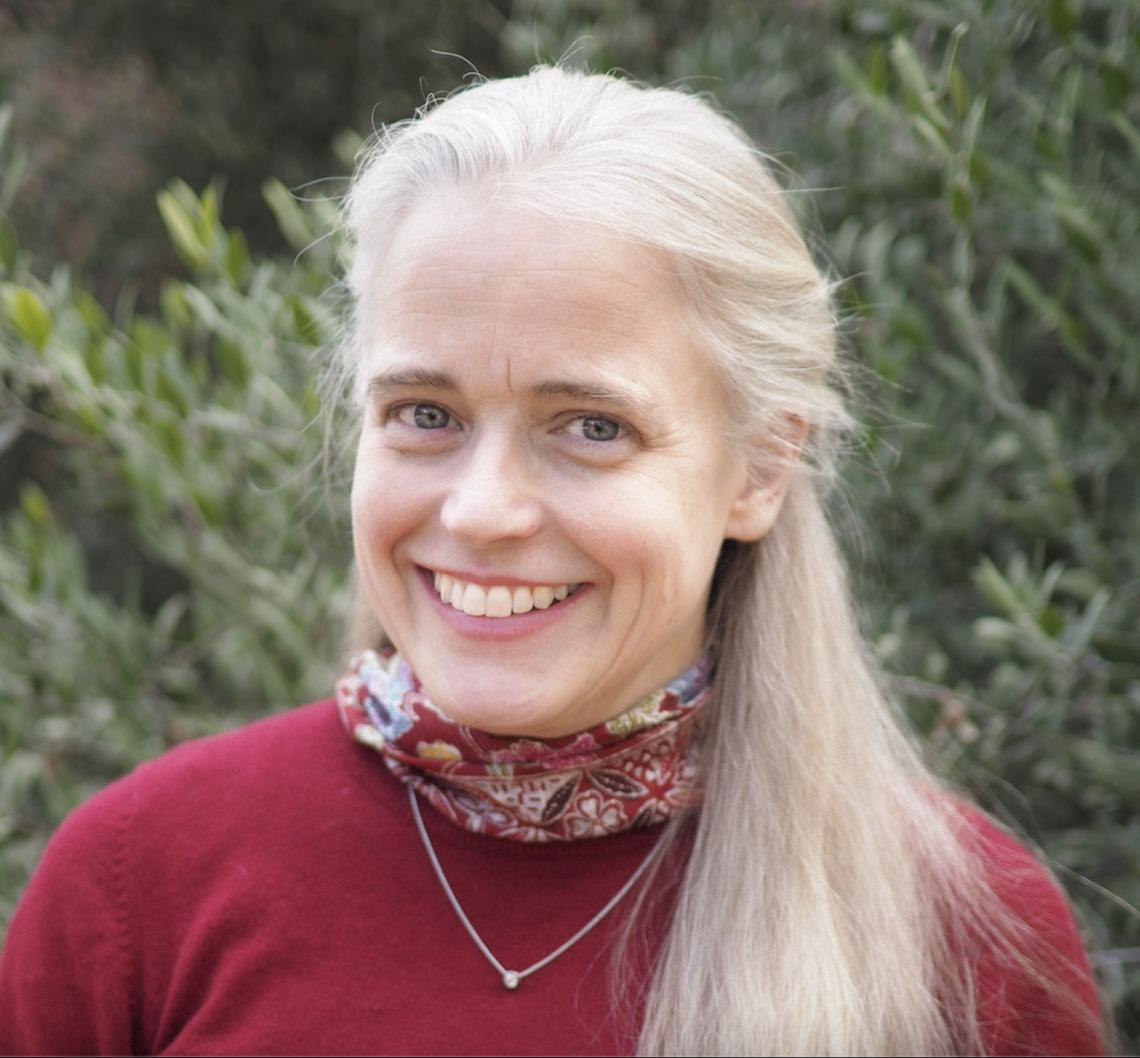
Dr. Linda S. Sparke is Professor Emerita of Astronomy at the University of Wisconsin–Madison, where she taught from January 1989 until her retirement on 7 May 2010 , rising from assistant professor to associate professor in 1992 and to full professor in 1997 . She took her degree in the Mathematical Tripos at New Hall, Cambridge, with first class honours in 1977, and then moved into astronomy at the University of California, Berkeley, completing an M.A. in 1979 and a Ph.D. in 1981 on *Swirling Gas Flows in Elliptical Galaxies* under Frank H. Shu .
Her research has been on the structure and dynamics of galaxies , specifically the observation and modelling of warped disk galaxies and polar rings, dynamical models for bars in spiral galaxies, and (since gravity is scale-free) circumstellar and circumbinary disks in eccentric stellar binaries . The thread running through it is the use of orbital motions as a probe: the American Physical Society elected her a Fellow in 2002 for 'studies of the structure and dynamics of galaxies, using orbital motions to probe both time-steady and time-varying gravitational potentials, and the distribution of dark matter' . She has published some 75 refereed papers, mainly in galactic structure and dynamics, active galactic nuclei and circumstellar disk dynamics, and trained six doctoral students and one postdoctoral scholar .
With Prof. John S. Gallagher III, also of UW–Madison, she wrote Galaxies in the Universe: An Introduction (Cambridge University Press, 2000; second edition 2007) , a deliberately 'with-calculus' text aimed at third- and fourth-year undergraduates who have completed a year or two of university physics . It won the American Astronomical Society's Chambliss Award for Astronomical Writing, and Korean and Chinese editions followed . She also served as Scientific Editor of *The Astrophysical Journal* from 2002 to 2004 and chaired the Department of Astronomy from 2001 to 2004, where she inaugurated the department's Board of Visitors to assist with private fundraising and put forward two tenure cases, both successful .
What distinguishes her record is the move from research into research administration without leaving the science behind. She spent two years as a Program Officer in Astronomical Sciences at the National Science Foundation from 2007 to 2009, then joined the Astrophysics Division at NASA Headquarters as a Research Program Manager in October 2009, working on competitions for research awards and for the PI-led Astrophysics Explorers missions . In 2014–15 she spent a year in Huntsville, Alabama with the team operating the Gamma-Ray Burst Monitor on the Fermi observatory , and she later served as Explorers Program Scientist, leading reviews for Small and Medium Explorer mission opportunities in 2019 and 2021. She was named a Fellow of the American Astronomical Society in 2020, in the inaugural class of 200 Legacy Fellows , and retired from NASA in January 2026 . She is a dual citizen of the United Kingdom and the United States .
Dr. Sparke's science sits where observation and dynamics meet. A warped disk or a polar ring is a visible anomaly; explaining it requires modelling the gravitational potential that produced it and testing that model against velocity data. Her polar-ring surveys, her work on disk ellipticity in nearby spirals and her dynamical models for bars are all exercises in that discipline , inferring invisible mass from visible motion. The APS fellowship citation put it exactly right when it singled out her use of orbital motions 'to probe both time-steady and time-varying gravitational potentials, and the distribution of dark matter'.
The textbook is the other half of her contribution, and it is a more demanding achievement than it looks. *Galaxies in the Universe* is a 'with-calculus' introduction, which means it takes third-year undergraduates seriously rather than either watering the physics down or assuming graduate preparation. That is why it won the Chambliss Award and why it has been translated into Korean and Chinese. Colleagues in the field teach from it; students meet the subject through it.
The last sixteen years at NASA and NSF matter for a different reason. Reviewing Explorer mission proposals requires exactly the judgement a journal referee needs: is the measurement feasible, is the analysis plan adequate to the claim, and does the team understand what could go wrong. Dr. Sparke has spent nearly two decades making that call on the largest scale in the field, and she brings that standard to the manuscripts APC reviews.
The APC Leadership Team American Publication ConsultantsTell us about your manuscript and we will match you with the right expert from our team.
Get A Free Quote